Mattress Technology
How Mattress Materials Respond to Adjustable Bed Movement
An adjustable base can turn a flat bed into a chair, a reading perch, or a modestly elevated place to rest. The mattress must follow along. Whether it does so comfortably depends on its materials, construction, dimensions, and the range of motion the base is designed to make.
A mattress on an adjustable bed is asked to do something that a conventional bed rarely requires: bend, then settle; bend again, then return to level. The movement may be gradual and quiet, but it is not incidental. Each change in angle asks the mattress layers to flex together without buckling, separating, pulling against the cover, or compromising the sleeper’s sense of support. A mattress that feels excellent on a rigid platform may behave differently when its center rises or its head and foot sections move independently.
That difference is not a simple contest between “flexible” and “stiff.” A mattress is a layered structure, and its response to articulation depends on how those layers are joined, how thick they are, what lies inside them, and where the base bends. Springs, foam, latex, fabric, and edge reinforcement each have their own way of accommodating motion. So do the base’s hinges and the mattress’s perimeter. Compatibility is best understood as a relationship between two constructions—not as a quality that belongs to the mattress alone.
For anyone comparing adjustable beds, the useful questions are practical. Does the mattress maker approve the model for use on an adjustable base? Does the mattress fit the base without overhanging or leaving a gap? Can it bend through the base’s full range without feeling pinched or losing its shape? And after the novelty of the first few adjustments has passed, does the arrangement still feel comfortable in ordinary use? Those questions help replace vague assurances with a more informed assessment.
What articulation asks of a mattress
“Articulation” is the movement of an adjustable base into different positions. Depending on the model, the head, foot, or both sections can rise or lower, often with a hinge or pivot near the transition between sections. The mattress bends at those points while its other areas remain supported. When the base returns to flat, the mattress is expected to recover its original profile.
A compatible mattress needs enough flexibility to follow that motion, but flexibility is only part of the job. It also needs to stay in place, distribute body weight in a way that remains comfortable, and resist distortion as it changes shape. The base may press into one portion of the mattress while another portion is lifted. Layers that slide against one another, or a cover that is stretched too tightly, can affect how the mattress feels even when the overall system can move.
Movement may also change where pressure is felt. Raising the head can shift the sleeper’s weight toward the hips and lower body; lifting the legs can alter pressure around the back of the knees. Those changes are features of the position, not proof of a mattress defect. But a mattress that compresses or flexes unevenly may make them more noticeable. This is one reason that compatibility and personal comfort should be considered together.
It helps to distinguish occasional adjustment from repeated use. A sleeper who raises the head briefly to read may place different demands on a setup from someone who changes positions several times each night or keeps the bed elevated for much of the day. Manufacturers’ guidance is the place to start: it can identify approved base types, support requirements, excluded models, and warranty conditions. General assumptions about one material cannot substitute for those instructions.
How common mattress materials respond
Material labels are a useful first clue, but they do not tell the whole story. “Foam,” “latex,” “innerspring,” and “hybrid” each cover a broad range of constructions. Two mattresses in the same category may differ considerably in thickness, density, spring design, quilting, and the way their layers are attached. A materials comparison should therefore be treated as a guide to likely behavior, not a verdict on a specific model.
Memory foam
Memory foam generally conforms under pressure and can bend with a changing surface. In an adjustable setup, that contouring may help the mattress follow the base rather than resist every change in angle. Its response varies by formulation and by the rest of the mattress: a thick foam comfort layer over a dense, inflexible support core will not behave exactly like a mattress made with several more pliable layers.
Foam can also feel different when its orientation changes. In a raised position, the body’s weight is redistributed, and the foam may compress more in some areas than others. Warmth, firmness, and response time can influence how noticeable that feels. The relevant test is not whether foam bends in theory, but whether the complete mattress is approved for the intended base and feels supportive in the positions a sleeper will actually use.
Latex
Latex is often resilient: it compresses and tends to spring back rather than slowly retaining a deep impression. That recovery can be helpful as a mattress follows the rise and fall of an adjustable base. But latex constructions vary. A single substantial slab, several thinner layers, and a mattress that combines latex with other materials can differ in how readily they articulate. The cover, quilting, and any firm perimeter components matter as well.
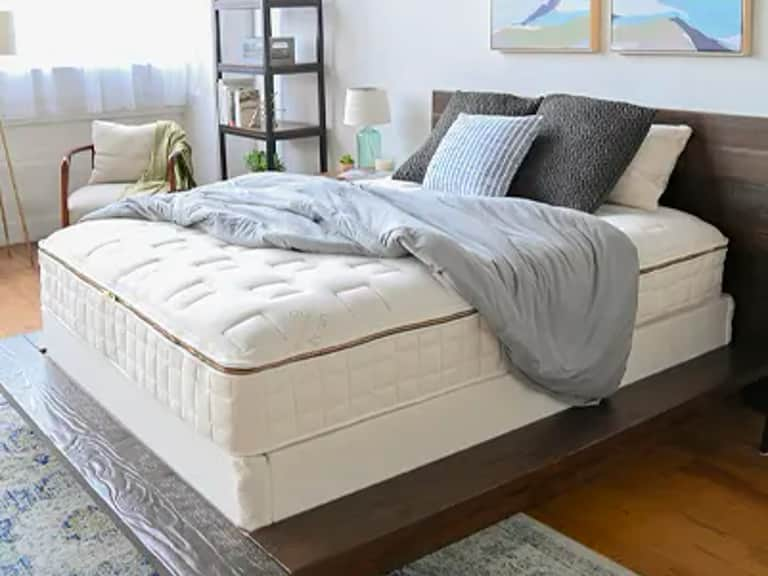
For a specific example of layered construction—not a general compatibility guarantee—the Naturepedic EOS Classic Mattress is described as having customizable latex comfort and support layers, with a separate pocketed-spring component in its construction. The product details do not, on their own, establish that a particular EOS configuration is suitable for every adjustable base. Anyone considering it for an articulated setup should check current manufacturer instructions for the exact model, configuration, and base.
Innerspring and pocketed-coil mattresses
“Innerspring” does not automatically mean rigid. Coil systems can respond to pressure at many points, and individually pocketed springs may move more independently than coils joined into a single interconnected unit. That distinction can affect how the spring layer behaves as the mattress bends. Yet a mattress is more than its coils. A dense border, stiff perimeter rod, substantial quilt panel, or heavily reinforced edge may limit flexibility even when the central coil unit can move.
Traditional connected-coil designs may transfer movement across a broader area, while pocketed coils are generally designed to respond more locally. Neither feature alone determines adjustable-bed compatibility. The spring unit must work with the upholstery layers and the base’s pivot points. A manufacturer’s specification for the finished mattress is more useful than a coil count or spring label in isolation.
Hybrid mattresses
A hybrid combines components—often coils and foam or latex—to balance different qualities. It may have a flexible spring unit beneath cushioning layers, or a comparatively firm assembly that resists bending. The word “hybrid” says something about the ingredients, not necessarily how the mattress will articulate. Pay particular attention to the support core, edge reinforcement, and overall thickness, then confirm that the exact hybrid model is approved for the base under consideration.
Natural fibers and surface materials
Wool, cotton, and other fibers can add cushioning, moisture management, and structure. In a mattress, they may appear as quilting, padding, or upholstery layers over foam or springs. Their effect on movement depends on their amount and arrangement. A relatively supple fiber layer is not the same as a rigid board or thick, tightly secured panel beneath it. Covers and tufting also affect how the surface stretches as the mattress bends.
Natural fillings do not make a mattress incompatible by definition, just as synthetic materials do not ensure compatibility. For a mixed-material mattress, the full construction and the manufacturer’s guidance remain decisive. A useful comparison asks how the finished mattress bends and recovers, rather than attaching a simple yes-or-no answer to the name of one fiber.
Thickness, support layers, and the shape of the bend
Thickness can influence how a mattress behaves on an adjustable base, though there is no universal cutoff that applies to every construction. A thicker mattress may contain more layers that must flex together; a thinner mattress may still include a stiff component that resists movement. Height also changes the leverage exerted as the base lifts a section, while the materials and bonding within the mattress determine whether those layers move as a cohesive unit.
The support layer is especially important. It carries much of the sleeper’s weight and provides the foundation for the comfort layers above. In a foam mattress, that layer’s firmness and flexibility affect how the mattress follows the base. In a spring mattress, the coil unit and its surrounding structure play a similar role. A comfort layer can feel soft and pliable while a lower layer remains too resistant for the base’s movement—or the whole assembly may flex smoothly because the components are designed to work together.
There is also the question of where the base bends. If a mattress’s construction includes a stiff crosswise element near a pivot, the movement may feel abrupt or create stress in the cover. If its layers are able to flex at that location, the transition may feel more natural. Without detailed construction information, it is difficult to predict the result from a showroom feel alone. Manufacturer-approved pairings and a careful home trial, where available, offer more meaningful evidence.
Finally, consider the mattress’s shape when raised. A base can create a shallow curve or a more pronounced angle, depending on its design and settings. The mattress should follow that shape without folding sharply, bowing away from the surface, or bunching at a hinge. These observations are not a substitute for technical approval, but they can help identify a poor fit before it becomes a routine part of the bedroom.
A practical compatibility checklist
Before buying a mattress or adjustable base, work through the details in this order. The process is less glamorous than choosing a fabric or testing a firmness level, but it can prevent an expensive mismatch.
- Check the mattress maker’s guidance. Look for an explicit statement about adjustable-base use for the exact model, not just the brand or material category. Confirm any conditions involving the base type, support surface, or permitted range of motion.
- Read the warranty terms. Determine whether use on an adjustable base is allowed and whether the warranty requires a particular style of base. Warranty language can distinguish between an acceptable setup and one that may affect coverage.
- Match the dimensions. The mattress size should correspond to the base size. Verify length and width, and check how a split design works if the base has independently moving sections. A mattress that overhangs or is too narrow may shift or be unevenly supported.
- Confirm thickness and weight limits. Check the base’s instructions for mattress-height guidance and weight capacity. Include the mattress, bedding, and sleepers when assessing load limits, as the manufacturer directs.
- Inspect the support surface. Find out whether the base uses a platform, slats, or another arrangement, and whether its support requirements match the mattress. A mattress can be flexible yet still require a particular kind of underlying support.
- Ask about retention features. Adjustable bases may use a retainer bar, fabric, or another system to limit mattress movement. Confirm that the mattress is compatible with the base’s method and that the restraint does not press awkwardly against the mattress.
- Consider how often positions will change. A setup used only occasionally for reading has different day-to-day demands from one that moves repeatedly through the night. Describe intended use when asking the manufacturer or retailer about fit.
- Understand the trial and return process. If comfort or compatibility is uncertain, know the terms before purchase. Find out how long the evaluation period lasts, what fees apply, and whether the mattress and base have separate return conditions.
It can help to write down the mattress model, its construction, the base model, and any relevant measurements before contacting customer support. Specific questions tend to produce more useful answers than “Will this mattress work with an adjustable bed?” Ask whether the exact pairing is approved, what limitations apply, and what to look for if the mattress does not track the base smoothly.
How to evaluate comfort in motion
Testing a mattress flat is necessary, but not sufficient. If you have access to the intended base, try the positions you expect to use. Raise the head gradually; notice whether the mattress follows the curve evenly and whether the cover pulls or wrinkles. Raise the legs, then return the bed to flat. A mattress should not need to be pushed back into place after ordinary movement.
Pay attention to the feeling of the whole surface, not just the hinge. Does the support remain even beneath the hips and shoulders? Does a raised position cause you to slide, bunch, or feel unexpectedly compressed? Do the edges remain stable when you sit or lie near them? These are personal comfort observations, but they can reveal how the mattress and base interact in real conditions.
Use the base’s controls as directed and avoid forcing a mattress into an angle it was not designed to accommodate. If you hear unusual creaking, see a persistent gap, or notice that the mattress shifts significantly, stop and consult the instructions or manufacturer. The sound may come from the base rather than the mattress, but guessing is less useful than checking the equipment. Never place objects beneath a moving section or attempt to defeat a safety or retention feature.
There is no need to cycle through positions dozens of times in a store. A few deliberate checks are enough to notice obvious problems, while questions about long-term wear require product-specific guidance. If the mattress is delivered later, repeat the basic fit check at home, keeping in mind that bedding and room layout can affect access to the base and its controls.
Everyday fit, care, and common misconceptions
Sheets and protectors are small parts of the system, but a tight fitted sheet can resist movement or pull at the mattress corners as the base rises. Choose bedding that fits the mattress’s dimensions and depth, and avoid tucking it so tightly that it limits articulation. A protector should stay in place without adding a rigid, constricting layer; check its care instructions and fit if the mattress changes shape noticeably.
Rotation and flipping instructions still come from the mattress manufacturer. Some mattresses are designed to rotate; others are not meant to be flipped, and some constructions have a clearly defined top. An adjustable base does not create a universal care schedule. Follow the instructions for both the mattress and base, and inspect the mattress periodically for shifting, unusual bunching, or damage to the cover.
One common misconception is that all foam mattresses work on adjustable bases. Many may be suitable, but the phrase “foam mattress” does not guarantee approval. Another is that any innerspring mattress must remain flat. Some spring systems can articulate; others may not be designed for it. A third is that a softer mattress is necessarily more flexible. Surface softness and structural flexibility are related only indirectly: a plush top can sit above a very firm support layer.
Nor does an adjustable base automatically improve sleep for everyone. Its usefulness depends on a sleeper’s preferences, habits, and comfort. The base and mattress should be chosen as a system, but the mattress still needs to feel right when flat—the position in which many people spend most of the night. If an elevated position is used for a health concern, advice from a qualified clinician may be more appropriate than relying on a mattress feature or a product description.
A clearer way to compare options
When comparing mattresses for adjustable-bed use, organize the information into three columns: what the manufacturer confirms, what the construction suggests, and what you can personally test. The first column should contain compatibility approval and warranty conditions. The second can note materials, thickness, support layers, edge reinforcement, and whether the design is modular or hybrid. The third records comfort and fit observations in the positions that matter to you.
This approach is more reliable than ranking materials as if they had fixed personalities. A pocketed-coil mattress may flex well in one construction and poorly in another. A layered latex mattress may follow a base smoothly, but its exact configuration still matters. Memory foam may contour around a bend, while the support core beneath it determines how the whole mattress moves. Construction details explain the possibilities; the maker’s guidance establishes whether a particular use is approved.
In the end, adjustable-bed compatibility is neither mysterious nor reducible to one magic specification. It is a matter of fit between a moving foundation and a layered sleep surface. Ask about the exact models, check the dimensions and instructions, consider the way the mattress is built, and test the positions you intend to use. The best pairing is not the one that performs the most dramatic bend. It is the one that moves predictably, stays supported, and remains comfortable when the bed is flat again.